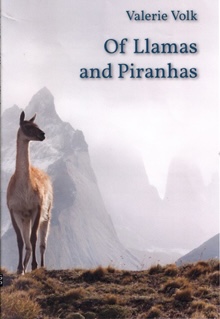
Of Llamas and Piranhas
2017
Valerie’s eighth published book.
Though the poems in this book take the reader on a South American journey from Chile to the Galapagos, it is not just another travel book. It’s a personal invitation in the form of a poem a day to join the writer in strange and exotic places. The spectacular beauty of cascading water at the Iguassu Falls, a weather beaten face in a Peruvian marketplace, the roasted guinea pig on the Last Supper table in Cusco Cathedral’s altar picture – these were among the triggers for the daily poem. Of Llamas and Piranhas is an individual record of moments that became memories.
Buy this book
See pricing & buy online →Cover Comments
— Antonia Hildebrand (Editor: Polestar Writers’ Journal).
— Rob Walker (Poet and critic).
— Mark Worthing (South Australian author and editor).
Excerpts
from En route – flexitime
from Takes two ...
from The comfort of the familiar
from Walking with tortoises: Galápagos
4 Reviews
The title poem of Valerie Volk’s collection, Of Llamas and Piranhas, captures the complexity of her travels in South America.
She has an eye for the scenes that will bring her stories to life. The brightly coloured townhouses on the steep hills of Valparaiso are like ‘products of a child’s paintbrush’ and ‘the sight of / tangled wires for stolen power,’ shows ‘grinding cycles of a poverty’ of the favelas in Brazil.
She looks below the surface of the popular tourist sights to uncover a complexity which deepens our knowledge of the fascinating continent.In ‘Plaza de Armas’ in Chile, she is not satisfied with the ‘tales of the Incan empire’ she wants to know about the Mapuche, the people ‘whose land this was / before sun-worshipping Incas.’ And on Machu Picchu she writes about ‘ancient Incan workers busy with / potatoes, melons, avoadoes,’ then describes a different crop, tourists of many different nationalities ‘so different, so diverse / on these same terraces.’
In a contrast of savagery and gentleness she takes us from the grasslands of the Andes where the llamas have ‘foolish fond soft muzzles’ and ‘gentle gaze’ to the Amazon waterways where piranha’s ‘jagged teeth are razor sharp / in predatory mouths.’ But in these poems nothing is quite as simple as it looks. ‘Llamas spit / And who knows? Possibly / piranhas love their young.’ She finds a similar juxtaposition in turmoil and peace at the Iguassu Falls where ‘plumes / of water spurt with force towards / a waiting sky’ and to seals which are ‘lazily at play / unfazed by spume and spray.’
In the jungle when the tourists note ‘the anaconda, coiled and deadly,’ trees with poisoned spines and enormous spiders they know ‘we’re right to treat / this expedition cautiously.’ But they also see their guide replace ‘every creature just where / it was found, anxious to preserve / the jungle life as it is meant to be.’
As we read these poems we realise that while we might travel through a different country as tourists we must also travel through time and our own lives.The poet shows us this when she describes the tango as ‘the dance of love’ and reminds us that love, like the dance, requires ‘learning /how to be together.’
At the end of her journey through this strange and wonderful continent she finds familiar patterns and reflects that ‘what we have been given / has been a time of richness / which like life itself … /demands our gratitude.’