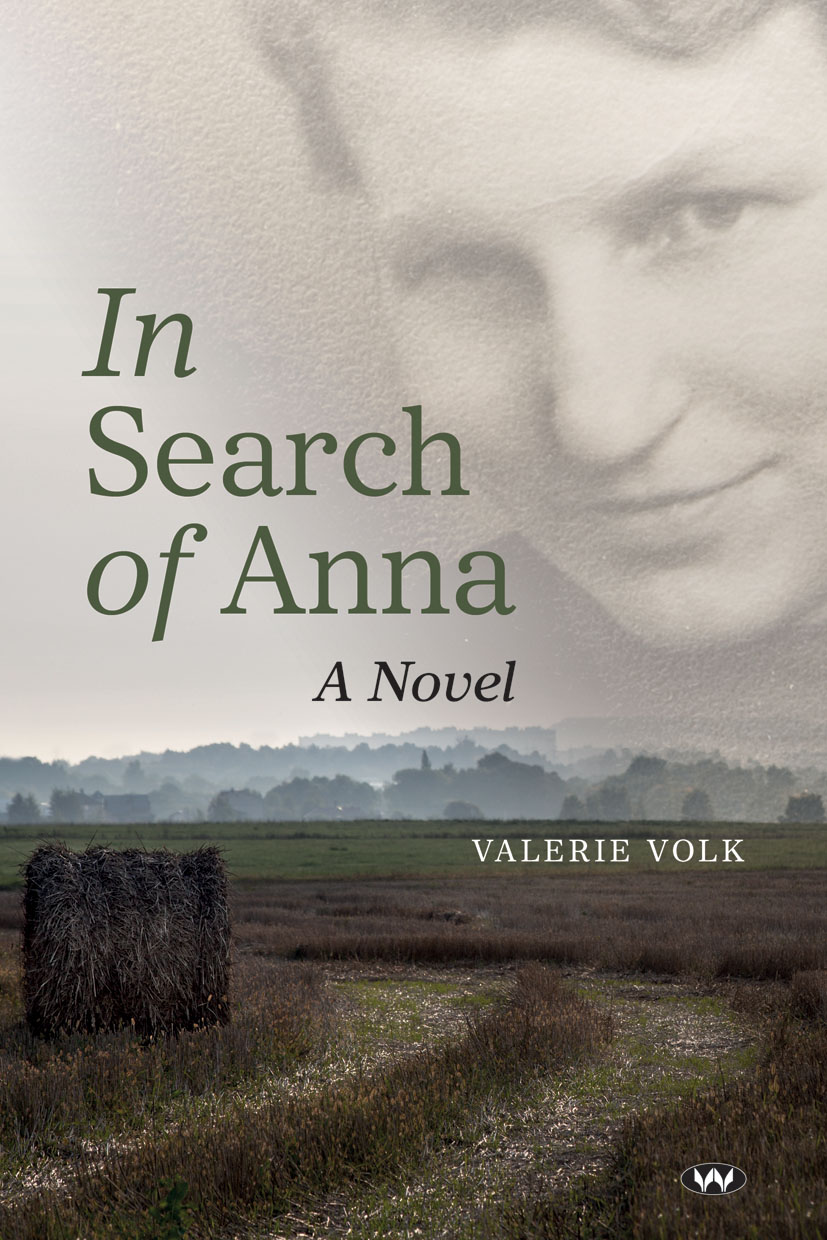
REVIEW: In Search of Anna by Valerie Volk Wakefield Press, 2019
Valerie Volk is a name familiar to Studio readers, mainly through her poetry. She has also published verse novels, short stories and other fiction. This novel places her family history on a wide historical canvas, with a vivid narrative overseen by the poet’s imaginative eye.
We begin with the Prologue: …Finally, I find it, another photograph, tiny, really just a miniature…She is the one I really want; that wandering spirit, the woman who gave birth to my grandfather and could not let him go…His mother, this older Anna, the one who came across the world in pursuit of her missing son, roams restlessly through the blur of these past faces as I reach through the fog of years…
I search among the wraith-like figures, seeking her, seeking Anna. She passes through that ghostly company and yearns towards me.
Take me, she says. Then perhaps I will rest in peace.
And it is this Anna, (the author’s great-grandmother), whose ‘voice’ we hear in the following story. It is the ‘voice’ of a passionate and determined and ‘soul-full’ person, tracing her life from childhood to adulthood. Accompanied by detailed historical research and re-creation, her story stretches from the German village of Lewin, in Silesia, in 1886, to Jindera, NSW, in 1898.
This is a grand and colourful tapestry, featuring a multiplicity of characters- German and colonial- and the artistic weaving together of several threads and their motifs. ‘Progress’ is one, seen in the ‘railways’ motif. For Otto, this is his source of work; for Anna, her means of escape, travel and delight; seen, for example, as she comes to Albury, in search of her son,
…the view out the windows seemed an unending sea of golden wheatfields. Hours were lost in apprehension. (p230)
Linked with this is the further motif of ‘steam’. It is ‘steam’ that fascinates Kurt in Germany; his interest moves to ‘steam’ in ships,…
It is not like the old days of sail, when the clipper ships depended on favourable winds for departure. This is another of the benefits of steam power…(p97)
The voyage to Victoria follows and his growing interest to harness ‘steam’ on the land. In the following passage, Anna connects Otto and Kurt and ‘steam’, as she views the Exhibition in Melbourne,…
But my mind had focussed on the steam locomotives on display. How this would have interested Otto…And Kurt, my son, who had replaced him (Otto) in my heart. How he would have loved such a display, with its show of steam power…(p189)
The image of the kaleidoscope (p202), is apt as Anna reflects on her life with its twists and turns and her search for Kurt. ‘Search’ is the dominant thread in the tapestry. Her search is for Kurt, and eventually she finds him. What, though, is her real ‘search’? At the end of the voyage to Melbourne, Anna expresses it, “I want to love, and be loved.”(p178). It is at Jindera, and her marriage of love to Carl, that this search is completed. The depth of it is shown as Anna grapples with the loss of this love on Carl’s death…
The pain of losing was vast, but the joy of loving, and of being loved, was even greater. The gift outweighed even the loss…(p318).
The ‘search’ thread is long, winding, yet binding in the tapestry. Anna has fulfilled her promise, “one day I may search for myself.”(p178)
Two further thoughts come from the ‘search’ thread. Anna’s search is undertaken, (increasingly as the tapestry takes shape), in the light of, “a divinity that shapes our ends.” It is her strong faith in God that gives her a confidence as well as a joy,…
Words that I had read came to life for me in ways I had never foreseen. “The lines are fallen unto me in pleasant places” -yes, the Psalmist had put it well.(P293). Importantly, it is there to sustain her in the time of her loss,…
Instead of the accusing, ‘Why me?’ perhaps it was a different question I should be asking: ’Why not me?’ For I could see that I had been given so much. The years of happiness. They had been an unanticipated gift. Old teaching came back to me, “The Lord gives, and the Lord takes away.” I understood these words. I had learned them from childhood. I tried to cling to this acceptance even in the times of total desolation.
The second is that the author’s own ‘search’ for Anna, is also completed. Anna has been discovered; the novel’s title has been realised. And we, as readers, have been graciously invited to enter and view the tapestry being woven.
We end with the Epilogue: But you have returned; you live again in my words. Perhaps now your wandering spirit can rest.