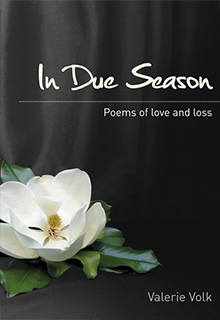
In Due Season
2010
A deeply moving debut. Valerie's first published book.
Early in 2008, when Noel Volk was diagnosed with multiple myeloma, a form of blood cancer, there was no anticipation of his death nine months later. However, in late March he was admitted to hospital, and was to remain there without break, with frequent periods of intensive care, until he died at the end of September.
Nothing could have prepared him or his wife for the experience that they shared.
Valerie wrote In Due Season, a collection of poetry sub-titled Poems of Love and Loss, as an expression of her feelings during the last year of her husband’s life. Writing became her coping strategy, a way of dealing with the experiences and emotions that the passing months brought. Its publication by Pantaenus Press was an unanticipated outcome.
The book of poems is both a chronicle of a year of great sorrow and great joy, and a recollection of Noel and Valerie's lives together. It is also a tribute to a remarkable man, and the richness of the marriage that Noel and Valerie shared.
The poetry is varied in both form and mood, ranging from formal and measured sonnets and rhymed poems, to the more anguished raw emotion of the free-verse poems. Throughout, there is a personal tone which makes this poetry accessible to all readers.
"In this moving and personal account of death in the family there is a deep feeling not only of loss but also of lives lived and shared, so that it becomes universal in its outreach. The technical accomplishment in the writing contributes largely to the achievement; I particularly admired the villanelle. The set of sonnets gives a boundary to the anecdotal account of hospital visits, pushing these into a memorable expression. In the free verse the poet does not lose the sense of command over line-lengths and the assured cadence that typifies the collection as a whole. The book deserves to reach a wide readership." (Thomas Shapcott. Professor Emeritus of Creative Writing at the University of Adelaide)
"No matter our colour or creed, our intellect or status, grief will humble, level and unite us. Yet in our holding of the pain and the love in the same moment we have the potential to be transformed. Valerie Volk, in her poems of grief, offers a voice to the strange confusion that confronts each of us. It is her gift to us." - Judith Murray, Senior Lecturer, School of Psychology, University of Queensland
Lecturers and counsellors in the grief and loss field believe that the feelings explored in these poems will be recognised by anyone who faces similar experiences.
Buy this book
See pricing & buy online →Poetry
Outside
All in the mind!
But commonplace …
from In Due Season ... closing lines.
3 Reviews
Insight column, Southern Cross
“How could you manage to write this book during the year that he was dying?”
Even the people who didn’t ask me the question often looked it - and I could understand why.
For most of 2008 my dearly-loved husband was in hospital. After a totally unexpected diagnosis of multiple myeloma (a form of blood cancer) in early January, he did not get the five to ten years of life that had been predicted. Instead, other problems put him in hospital from the end of March until his death on September 30.
Nine months. Six of them in hospital, in and out of intensive care until that ward became our second home. A year that now, twelve months later, I look back on with a sense of incredulity. A year that was both terrible, and yet wonderful.
It was a year of amazing and fulfilling closeness, in which we spent every day together, a gift that not all couples who face death have the privilege of experiencing. It was also a year of spiritual strengthening for all who knew him, as we watched the unfaltering certainty of his faith.
And it was the year in which I found – I was given – another way of coping with all that happened. Writing had always been important to me. Now in writing poetry there was a way of expressing all the anguish and the misery of this time, but also the unexpected flashes of joy, the enduring happiness of being together during these months, the comfort of small memories and recalled experiences.
After he died, I continued to write, and in times when feeling was unbearable I would find myself reaching for pen and paper, and deal with the pain by letting it flow into the words I was writing, the poems I was creating.
I had never planned or expected to publish this very personal record of the year, but a small publishing house in Adelaide, Pantaenus Press, convinced me that what I had written might be of value to others facing similar experiences, that it might offer them a way of articulating feelings they did not know how to put into words.
It seems to be so. I have had heart-warming letters, emails, phone calls from others who have walked, or are walking, down this same road. But the poems are not only poems of grief; they are also a celebration of love and life and gratitude to God. They are poems for anyone who has ever loved, and all who recognise that one day lovers must part.
Southern Cross NSW (May 2009)