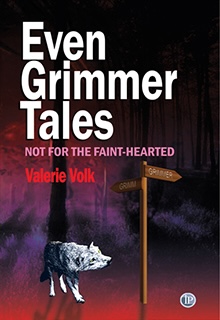
Even Grimmer Tales
2013
Wickedly subversive and sinister retellings. Valerie's third published book
A homicidal pedophile in Red Riding Hood’s forest, a necrophiliac whose worst nightmare comes true when Sleeping Beauty wakes up, a self-seeking and manipulative Goldilocks, a Cinderella whose shoe salesman rescues her from a not too appropriate home situation, a Frog King whose transformation does not bring the expected joy to his princess - these are just a few of the people who inhabit a disconcertingly twisted universe.
This collection of ‘Even Grimmer Tales’ takes the already dark world of the Brothers Grimm and, against the background of twelve well-known stories, explores what the writer in her preamble calls the ‘caves and crannies of the human mind’ – darker places than even the original story-tellers envisaged.
With precision and a fine sense of the ironic, these twelve verse stories – definitely not for children’s bedtime reading – touch on many of the well-known, and some lesser-known, forms of deviant behaviour, but leave the reader with a wry smile to echo the Epilogue’s closing line:
“There, but for God’s good grace, go I.”
You’ll never again read Grimms fairy tales the same way.
Buy this book
See pricing & buy online →Cover Comments
— - Peter Goldsworthy, Writer
Poetry
From the revised Cinderella ...
From The Princess and the Frog
From Goldilocks and the Three Bears
The Fisherman and his Wife
5 Reviews
Many fine stories have been written which began with the writer thinking: Suppose we look at the whole thing from a different angle?
Each of Valerie Volk's considerations of these familiar tales begin with following up this question. The re-imagined characters and situations, then, lie in wait for us as, once, the original tales which the Grimm Brothers collected, also waylaid them...
If the folk-tales which the Brothers Grimm published and made world famous are to have sceptical 21st-century interpretations, Valerie Volk's Even Grimmer Tales fill the bill admirably. Here, we have such familiar tales as 'Little Red Riding Hood', 'The Frog King', 'Cinderella', 'Sleeping Beauty', 'Snow White', 'Rapunzel', 'Hansel and Gretel', 'Thumbling', and 'Puss in Boots' re-invented for the present world. What gives Volk's re-interpretation of the special appeal is the consistently ironic treatment of the relationship between the characters as a whole.
In the Grimms' original versions, problematic as the vulnerable central figures' circumstances were, the punishment meted out to the wicked was also memorable. Recent research has shown, incidentally, that early 19th-century legal punishments in Germany were similarly harsh. The roles and behaviour of central characters in Volk's Even Grimmer Tales however are humanised and made far more in tune with present moral expectations. They all speak for themselves, putting the case for their particular reactions to oppression or to opportunities for exploitation with a defensive vigour. We recognise instantly that it is our world. And, just as many of the Grimm Brothers' tales have their imaginative equivalents in other cultures, so, too, Volk's re-alignments of themes offer us a compelling view of drives and compulsions readily recognisable to today's readers.
In Even Grimmer Tales the central characters all speak in dramatic monologues; we, as readers, are the immediate audience. They speak in the knowing tones we recognise as our world with its lusts, gratifications, and special pleading. Central characters each play roles as might some fictional Craig Thomson... But, to refresh the memories of those readers who may only vaguely remember a particular Grimm tale, Volk has wisely prefaced each of her strikingly different versions (in well-handled free verse) with a summary of the original Grimm tale, including the occasional contemporary aside as a hint of what's to come.
The illustrations to the summaries of the original tales are absolutely charming, further enhancing the sense of their two worlds, the Grimms' and ours.
The interpretations of characters, in Volk's witty enactments are not for what used to be called 'the little ones'. Rather, they are specifically addressed to 'a mature reader'.
That is, for those who have already (at least, temporarily) plunged into the mordant vale of scepticism. These are very much modern tales, where retribution is, from the start, a two-way process to which many readers will instantly respond. The red-hot shoes are cobbled in contemporary terms. The ferocious deaths are gone, but the ironies of living are correspondingly enhanced in Volk's innovative telling of the tales.
Bruce Dawe